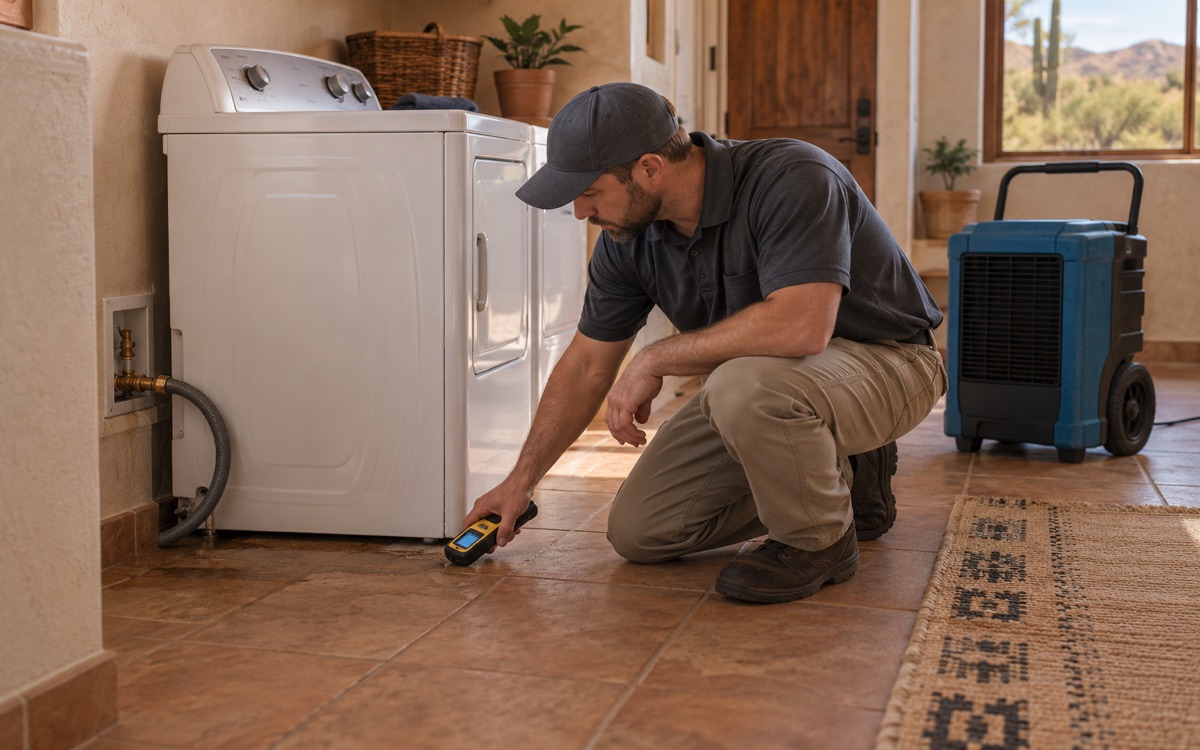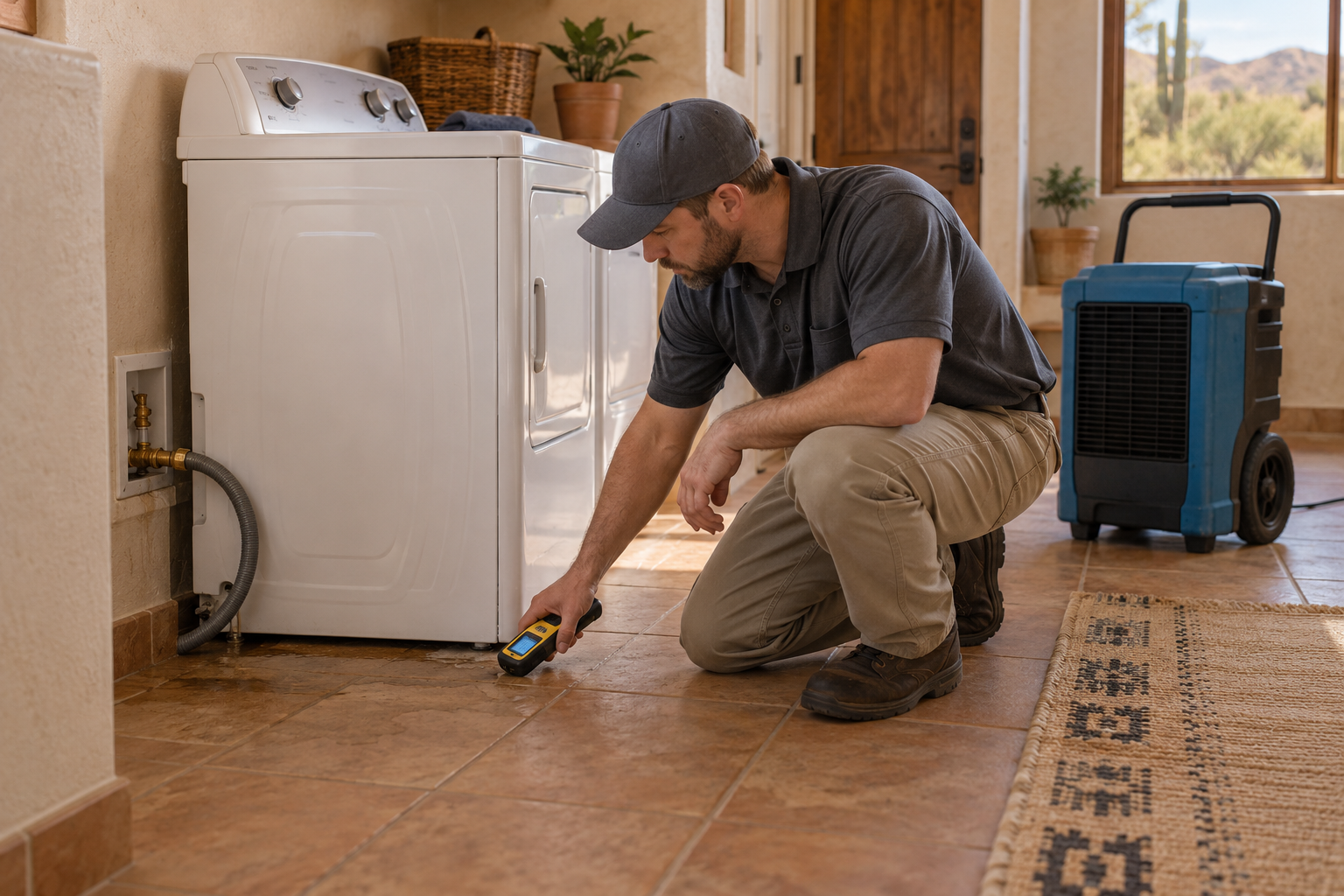

Does Phoenix's Dry Climate Make Flood-Damaged Buildings Dry Faster?
Phoenix's climate can influence drying conditions, but it does not guarantee that a flood-damaged building will dry quickly or completely on its own. Moisture can remain in concealed layers and poorly accessed assemblies. Indoor conditions, material type, source control, and measured progress determine the restoration plan.
The dry-desert assumption is understandable: a wet surface outdoors may improve rapidly in the sun. A wall cavity or layered floor is a different environment. Treating the weather as proof of dryness can leave damage hidden until finishes swell, odors develop, or later repairs reveal retained moisture.
An indoor assembly does not experience outdoor weather directly
For example, moisture under a retained floor finish has a different path out than water on an exposed concrete surface. The construction determines what the assessor needs to check.
Finishes, insulation, flooring layers, and enclosed voids limit how moisture moves out of a material. A surface exposed to room air may dry differently from the layer behind it. The visible improvement therefore tells only part of the story.
A Phoenix home may also be closed, cooled, or partly isolated during restoration. Those indoor conditions influence the work. Rather than assuming the outside forecast answers the question, ask how the affected materials and indoor environment are being assessed. The relevant goal is verified recovery of the assembly, not simply a room that feels less humid.
Evaporated moisture still needs to leave the work environment
As wet materials release moisture, indoor humidity can change. Controlled drying may involve dehumidification and directed air movement after contamination and safety are addressed. The equipment is selected to support the actual materials and conditions, not because every desert property needs the same setup.
Opening windows or running air conditioning is not automatically equivalent to that plan. Outdoor conditions vary, and an affected HVAC system may require evaluation before use. The CDC's reentry guidance addresses flood-exposed systems. Do not operate potentially affected equipment just to create more airflow.
Source correction matters more than waiting for sunshine
If water continues entering through a leak or storm opening, favorable weather alone cannot resolve the loss. The source may stop visibly when rainfall ends while the underlying defect remains. A later Phoenix storm can then introduce new moisture into the same assembly.
The EPA emphasizes fixing the source of moisture. Coordinate that correction with the restoration work and tell the crew about renewed entry. A drying record is most useful when it distinguishes moisture already being removed from fresh water arriving during the project.
Use measurements before replacing finishes
Surface touch, lack of odor, and elapsed time do not establish the condition of concealed materials. Appropriate readings and material inspection help determine whether the plan is working and whether further access is needed. Ask what is being checked and which parts remain unconfirmed.
The EPA recommends prompt drying of flooded materials, ideally within 24–48 hours, but that is urgency guidance rather than a guaranteed project length. Some materials require removal or different treatment. Before flooring or wall finishes cover the area, the decision should reflect actual condition and source status, not the belief that Arizona heat must already have taken care of it.
An exterior weather reading cannot serve as the baseline for every indoor material. A wall's construction, finish layers, and position within the affected area can differ from an exposed surface nearby. The technician should explain which comparison is appropriate for the assembly being tested. That turns a broad discussion about desert climate into a specific check of whether the remaining material has reached the project's drying condition.
Questions about Phoenix weather and flood drying
Can I skip dehumidifiers because Phoenix is usually dry?
Not on climate alone. Indoor humidity, moisture load, material layers, and the controlled drying plan determine whether dehumidification is needed.
Does a hot afternoon dry moisture behind a wall?
Not reliably. Concealed assemblies may have limited drying paths. Their condition needs assessment rather than inference from outdoor temperature.
Should I open every window to use desert air?
That depends on current outdoor and indoor conditions, safety, and the restoration plan. Coordinate ventilation with the team instead of changing an established setup without discussion.
Verify the drying condition inside your Phoenix building
If surfaces look better but hidden moisture remains uncertain, request an assessment of the assembly rather than relying on the outdoor climate.
Structural Drying & Dehumidification and Moisture Detection & Mapping evaluate indoor materials instead of assuming desert air completed the work. Request Service or call (602) 902-1375 to discuss the affected property.