
Why Is Water Source Repair Important Before Rebuilding in Phoenix?
Water source repair is important because new finishes can be damaged again if the original leak or entry path remains active. Before rebuilding, the restoration team and the appropriate repair professional should establish what caused the intrusion, what was corrected, and whether the affected assembly is ready to close.
Removing wet materials and repairing the source are related tasks, but they are not interchangeable. A dry interior today does not prove that a roof or drainage defect will withstand the next Phoenix storm. Likewise, a repaired supply connection does not prove that the surrounding materials have finished drying.
Identify the Source Without Guessing From the Stain
Water can travel along framing, beneath finishes, and through concealed spaces before it becomes visible. The location of a stain therefore helps guide an investigation but may not identify the entry point. Record when the damage appeared, whether rain or plumbing use was occurring, and whether it has happened before.
In Phoenix, wind-driven rain, surface runoff, roof defects, and indoor plumbing failures can require different specialists. The city's monsoon guidance describes rapidly changing storm conditions and runoff concerns. An interior repair plan should account for the identified source, not assume that every storm-related wet area came through the roof.
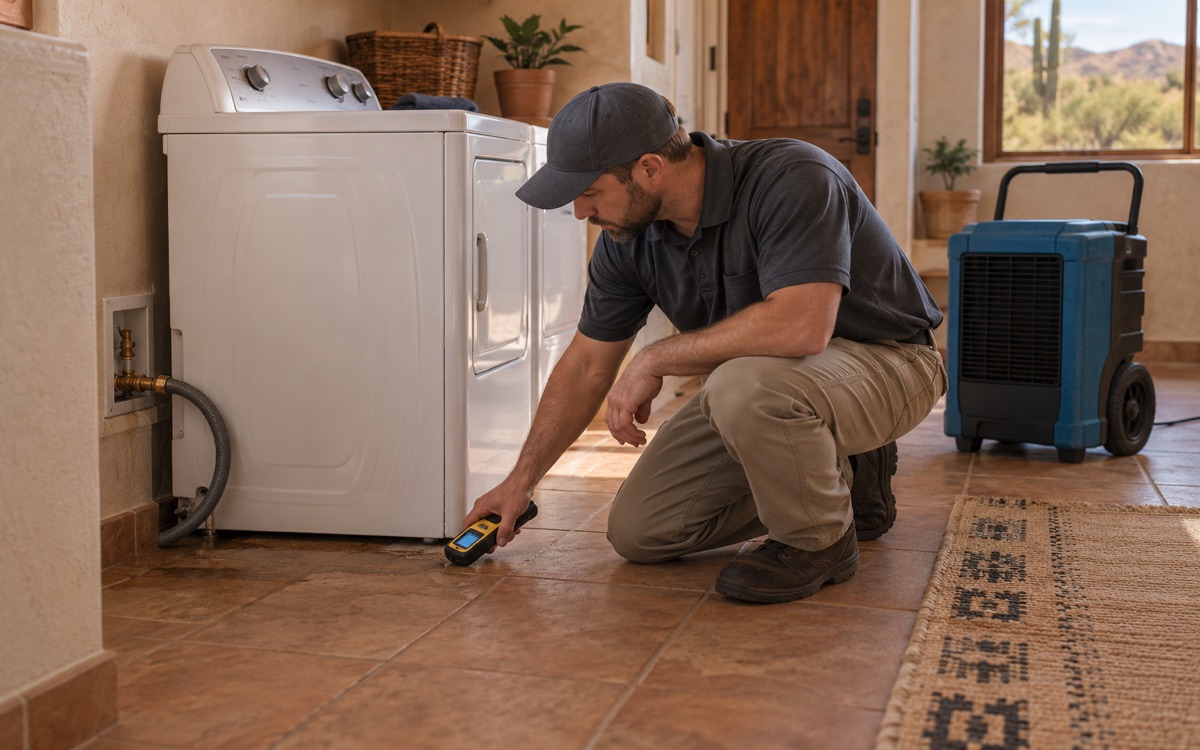
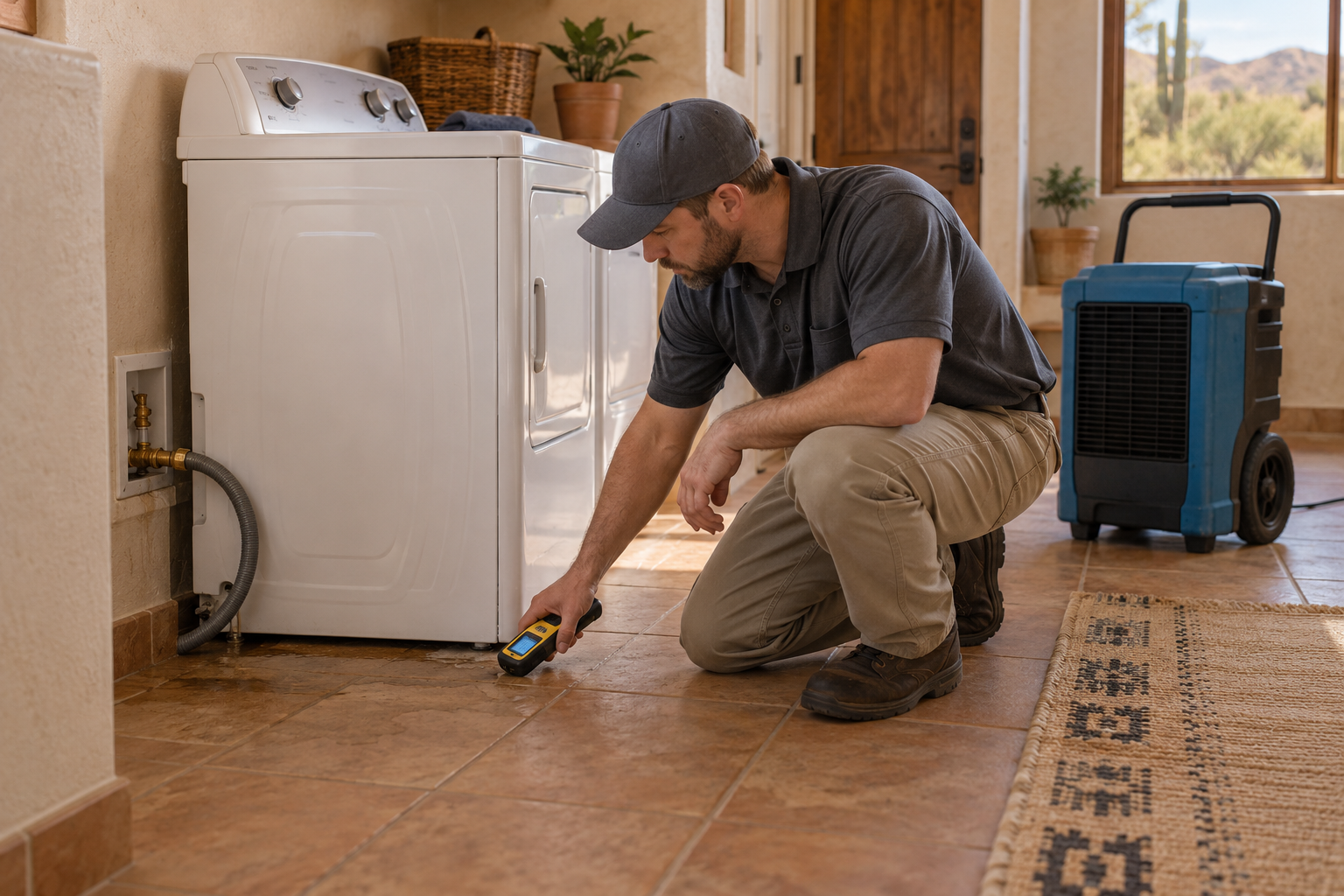
A flood damage assessment records the affected materials and observed conditions. Where the cause needs plumbing, roofing, drainage, or other specialist evaluation, that investigation should be coordinated rather than replaced by speculation.
Separate Stabilization From a Permanent Repair
Temporary measures can help limit further damage while a permanent repair is arranged. They may not be designed to remain in service indefinitely or withstand every subsequent event. Ask what the measure does, what its limitations are, and who is responsible for monitoring or replacing it.
A written plan can distinguish three separate milestones: the active water has stopped, the source has been permanently repaired, and the building materials are ready for reconstruction. If those dates differ, the schedule should explain how the property will be protected in the meantime.
- List the suspected and confirmed sources separately.
- Identify the contractor responsible for correcting each source.
- Record temporary protection and its limitations.
- Keep the repair documentation with the restoration records.
Verify Drying Independently of Source Correction
Stopping water prevents continued input, but moisture already inside a material still needs attention. Concealed layers may remain wet after the visible surface has changed color or feels dry. Covering them can make later assessment more difficult and expose new finishes to the same unresolved moisture.
EPA's moisture guidance emphasizes correcting the water problem as well as addressing affected materials. A coordinated mitigation plan therefore includes both source control and assessment of the damage already present.
Ask how the team decides an assembly is ready for closure. The answer should relate to the material condition and documented measurements, not merely the number of days equipment ran. Any area that could not be inspected should remain a disclosed limitation, rather than being described as verified dry.
Agree on Who Authorizes Rebuilding
Projects become confusing when each contractor assumes another has approved the next step. Establish one point of contact who tracks the source repair, drying status, required inspections, and selections. The contractor installing the replacement finish needs the relevant information before concealing the work.
For a recurring rain entry problem, ask the responsible professional how the repair was evaluated and what follow-up is appropriate. Do not create an improvised water test that could introduce more damage. Some conditions require observation during a later weather event; if uncertainty remains, discuss how that affects the reconstruction decision.
Keep source correction costs and damage restoration costs clearly described. Insurance may treat them differently, and the restoration company cannot promise how your policy will respond. A precise invoice is more helpful than combining everything under a vague “flood repair” heading.
Questions About Source Repairs
Can emergency cleanup start before the source is permanently repaired?
It may be necessary to stabilize damage while a permanent repair is arranged. The crew needs to understand whether water is still entering and whether the area is safe to work in. Cleanup is not proof that source correction is finished.
What if the source only leaks during heavy Phoenix rain?
Explain that pattern to the assessor and relevant building-envelope or drainage professional. Timing, photographs, and prior repair records can help narrow the investigation without assuming the visible stain identifies the defect.
Does a dry moisture reading prove the source is fixed?
No. It describes a material's condition at the measured location and time. Source correction and drying verification answer different questions, so both should be addressed.
Rebuild With the Cause and Damage Addressed
Phoenix Flood Restoration can help assess water damage and coordinate the restoration sequence. Request Service or call (602) 902-1375 with the source information, previous repairs, and any signs of recurring moisture.